

Complete Guide
Import cars from japan to South Africa 🇿🇦
Import Japanese Cars to South Africa I Complete Guide
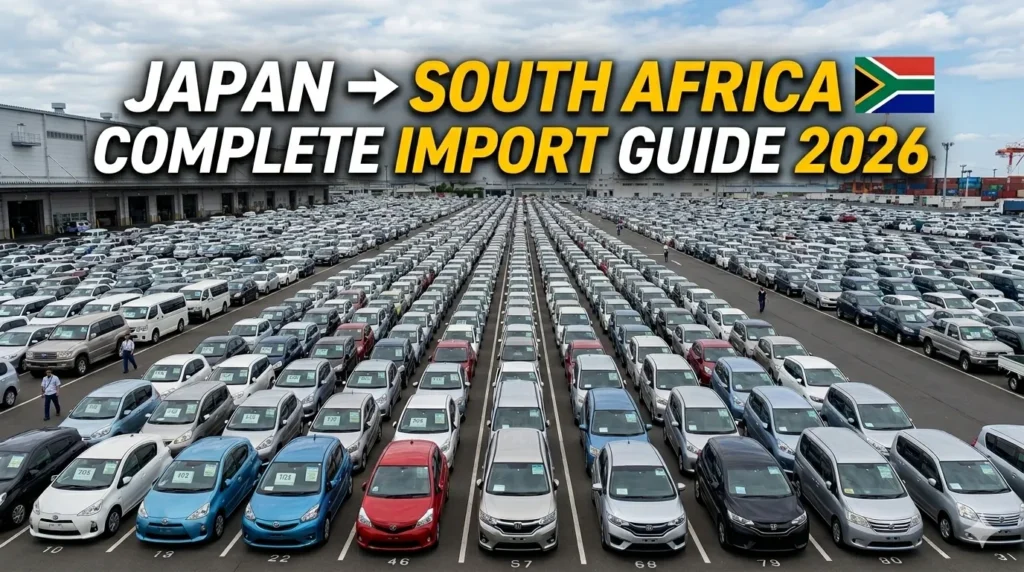
South Africa is one of Africa’s largest importers of Japanese used vehicles, with over 33,900 units arriving in 2024 alone. From the iconic Toyota Hilux dominating the bakkie market for over 50 consecutive years, to the rugged Land Cruiser Prado and fuel-efficient Honda Fit Japan’s used car market offers South African buyers unbeatable reliability at competitive prices.
But importing a car from Japan to South Africa involves multiple government agencies, permits, taxes, and compliance standards. This guide walks you through every step, every cost, and every document so you arrive at the port fully prepared.
Read Also: Kenya import guide
Why South Africa Loves Japanese Cars
South Africa’s used car market thrives on Japanese imports for very good reasons:
Reliability Built for African Conditions Japanese vehicles especially Toyota, Nissan, Honda, and Mitsubishi are engineered for longevity. Models like the Toyota Hilux and Land Cruiser Prado are legendary for surviving South Africa’s diverse terrain, from Cape Town’s urban streets to Limpopo’s rugged bush roads.
Right-Hand Drive Compatibility South Africa drives on the left side of the road exactly like Japan. This means Japanese Domestic Market (JDM) vehicles are immediately compatible. No steering conversion required.
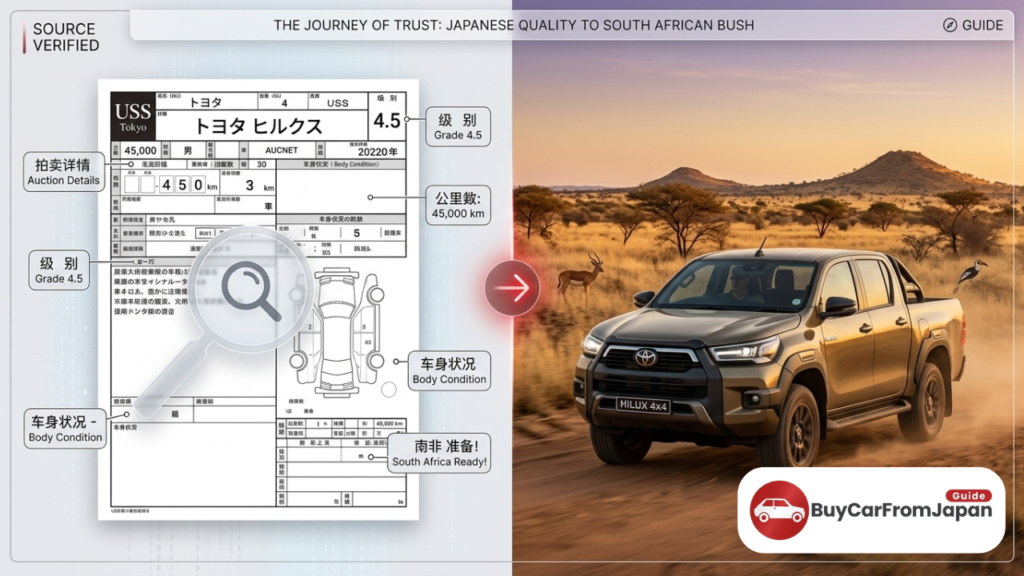
Transparent Auction Grading System Every car sold through Japan’s auction network carries a detailed auction sheet graded from 1 (poor) to 6 (immaculate), with documented mileage, accident history, and damage points. Buyers know exactly what they’re getting before the car ships.
Strong Parts Availability Toyota, Nissan, Honda, and Mitsubishi all have established dealer networks in South Africa. Parts for popular JDM models are widely available and affordable.
Trade Figures That Speak for Themselves In 2025, South Africa imported over $2.57 billion worth of vehicles and vehicle parts from Japan making Japan one of South Africa’s most critical automotive supply partners.
Most Popular Japanese Cars Imported to South Africa
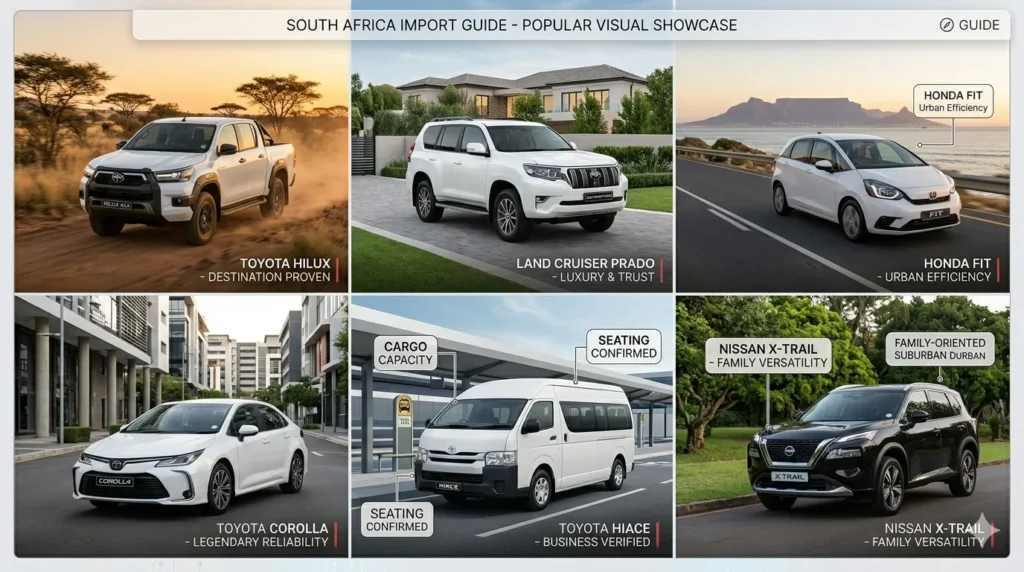
Toyota Hilux
These are the top JDM models that South African buyers consistently seek from Japan’s auction market:
The Hilux needs no introduction in South Africa. It has been the country’s best-selling bakkie for over 50 consecutive years. Japanese auction markets offer pre-facelift and current-generation Hilux models in outstanding condition, often with low kilometres and full service history.
- Why it’s popular: Bulletproof durability, massive ground clearance, diesel engines that run forever
- Typical import from Japan: 2018–2022 models, GD-6 2.8L turbodiesel
- Best for: Farming, construction, off-road, commercial use
Toyota Land Cruiser Prado
Arguably the king of Japanese exports to Africa in 2025. The Prado’s 2.7L and 4.0L engines are known for thriving in extreme heat and off-road conditions. In South Africa, it commands premium resale value.
- Why it’s popular: Prestige, off-road capability, legendary reliability
- Typical import: 150 Series (2009–2022), TZ-G and VX grades
- Best for: Game farms, executive transport, family adventures
Toyota Corolla / Corolla Axio
The global benchmark for sedan reliability. The Corolla is South Africa’s go-to for everyday commuting easy to maintain, cheap to insure, and comfortable for long-haul drives.
- Why it’s popular: Fuel efficiency, low running costs, widely serviced
- Best for: City driving, family sedan, Uber/e-hailing operators
Honda Fit (Jazz)
A compact hatchback with surprising interior space and a punchy 1.3L or 1.5L engine. The Honda Fit is popular among urban South African buyers who need a reliable daily driver with excellent fuel economy.
- Why it’s popular: Tight turning radius, boot space, urban agility
- Best for: Students, city commuters, first-time car owners
Toyota Hiace (Minibus / Panel Van)
The backbone of South Africa’s minibus taxi industry and small business transport. Japan’s used Hiace market offers low-mileage examples in excellent condition.
- Why it’s popular: Seating capacity, cargo space, Toyota reliability
- Best for: Minibus transport, shuttle operators, cargo delivery
Nissan X-Trail / Qashqai
A versatile compact SUV that offers Japanese engineering with European-style comfort. Growing in popularity across South African cities.
- Why it’s popular: AWD variants, modern tech, fuel-efficient CVT
- Best for: Family SUV, weekend adventures
Mazda 3 / Mazda 6 / CX-5
Mazda’s SKYACTIV engines are renowned for fuel efficiency. Popular among South African buyers who want Japanese reliability with premium build quality.
Mitsubishi Pajero / Triton
For buyers who need serious off-road ability at a lower price point than a Land Cruiser, the Pajero and Triton are excellent Japanese alternatives with strong South African parts support.
South Africa Car Import Eligibility I Who Can Import?
South African law places strict restrictions on who may import used vehicles. Import permits are issued only under specific circumstances to control the volume of used vehicles entering the country and protect the local motor industry.
Eligible Categories
1. Returning South African Residents South Africans who have lived permanently abroad and are returning to South Africa may import one motor vehicle free of customs duty and VAT, provided:
- They are the registered owner of the vehicle for a minimum of 12 months
- They are changing their permanent residency back to South Africa
- They can prove permanent residence abroad (not temporary workers or students)
2. Bona Fide Immigrants Foreign nationals who are permanently immigrating to South Africa and hold a permanent residence permit from the Department of Home Affairs may import one vehicle.
- Must present the permanent residency certificate from Home Affairs
- Must own the vehicle and have it registered in their name prior to importation
3. Inherited Vehicles A vehicle inherited as part of a deceased estate may be imported with appropriate estate documentation and a valid ITAC permit.
4. Special Categories
- Racing cars (for approved events)
- Vintage or collector vehicles
- Specially designed vehicles for disabled persons
- Vehicles not otherwise commercially available in South Africa
Critical Rule: Used vehicles cannot be imported into South Africa for commercial resale. Private commercial importation of used JDM vehicles is not permitted. The permit system is strictly for personal-use imports under the categories above.
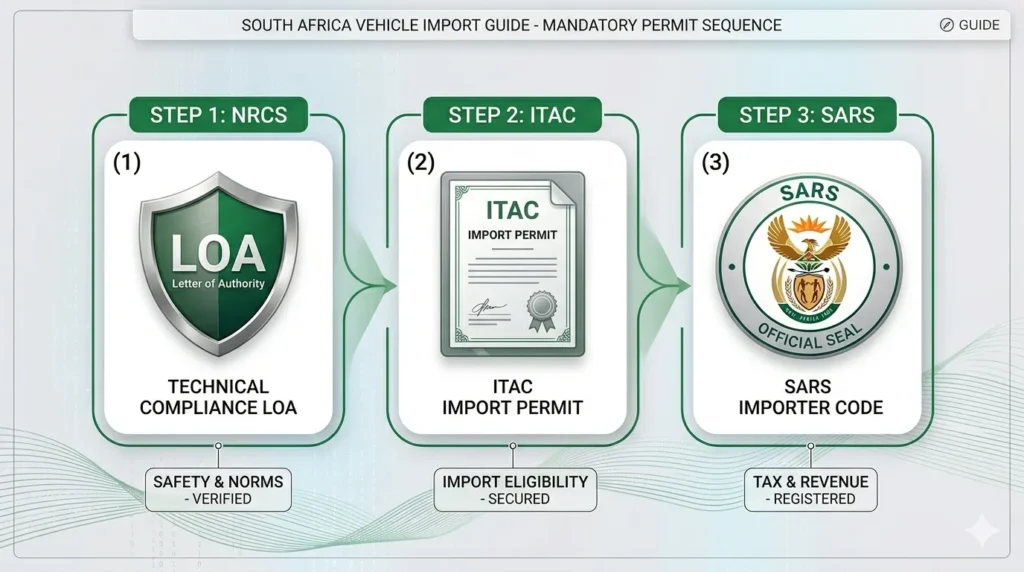
3 Mandatory Permits & Approvals Before You Ship
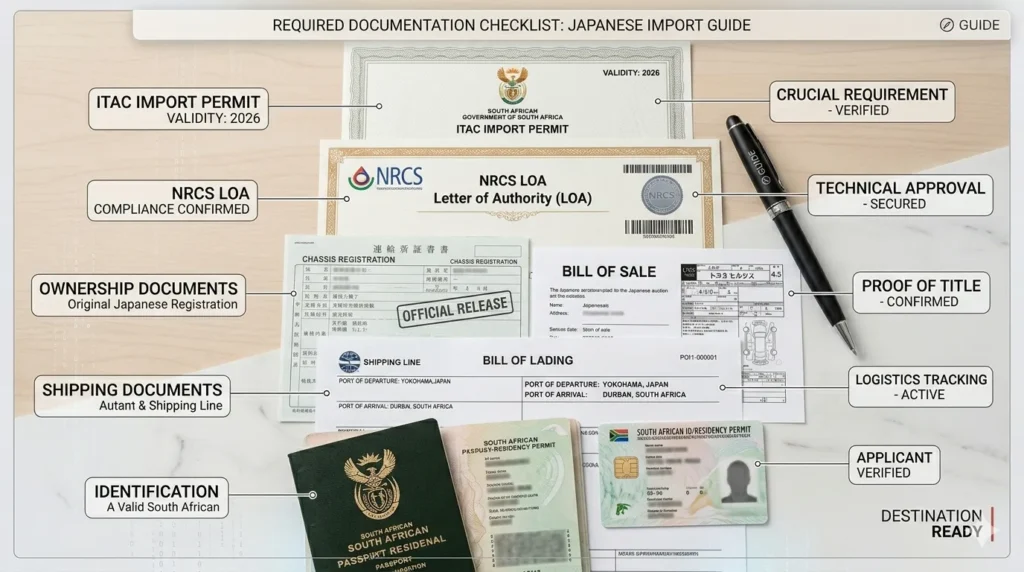
This is where many importers make costly mistakes. These permits must be secured before your vehicle leaves Japan. Without them, your car cannot clear South African customs or be registered for road use.
Permit 1: Letter of Authority (LOA) — NRCS
Issuing Body: National Regulator for Compulsory Specifications (NRCS) Contact: +27 12 482 8700
The NRCS Letter of Authority confirms that the imported vehicle meets South Africa’s compulsory safety, technical, and environmental standards. Without the LOA, the vehicle cannot be registered for road use in South Africa even if customs duties are fully paid.
How to Apply:
- Complete NRCS Application Form LA01
- Pay a non-refundable application fee (ZAR 300–ZAR 1,800 depending on vehicle type and age)
- Processing takes approximately 5 working days after all documents are received
Permit 2: Import Permit — ITAC
Issuing Body: International Trade Administration Commission of South Africa (ITAC) Form: IE462 (Application for Import of Second Hand Passenger Vehicle) Address: 77 Meintjies Street, Block D, Sunnyside, Pretoria Tel: 012 394 3590 / 012 394 3591
The ITAC Import Permit authorises the physical importation of the used vehicle into South Africa. It is issued under the International Trade Administration Act (No. 71 of 2002).
Documents for Returning SA Residents:
- Completed Form IE462
- Certified copy of South African ID document or passport
- Proof of emigration from South Africa
- Proof of permanent residence abroad (not temporary)
- Evidence that permanent foreign residence has been withdrawn
- Certified copy of official foreign vehicle registration certificate
Documents for Immigrants:
- Completed Form IE462
- Copy of South African permanent residency certificate
- Proof of ownership of the vehicle abroad
Important: ITAC does not charge service fees for the permit. However, vehicles imported under these permits typically cannot be sold or disposed of for two years after import.
Permit 3: SARS Importer Registration
Issuing Body: South African Revenue Service (SARS) Form: DA 185
To import any goods into South Africa, you must register as an importer with SARS and obtain an importer’s code. This is done via SARS eFiling. Once registered, your vehicle customs clearance will be processed under your importer code.
South Africa Car Import Duty & Tax Structure 2025
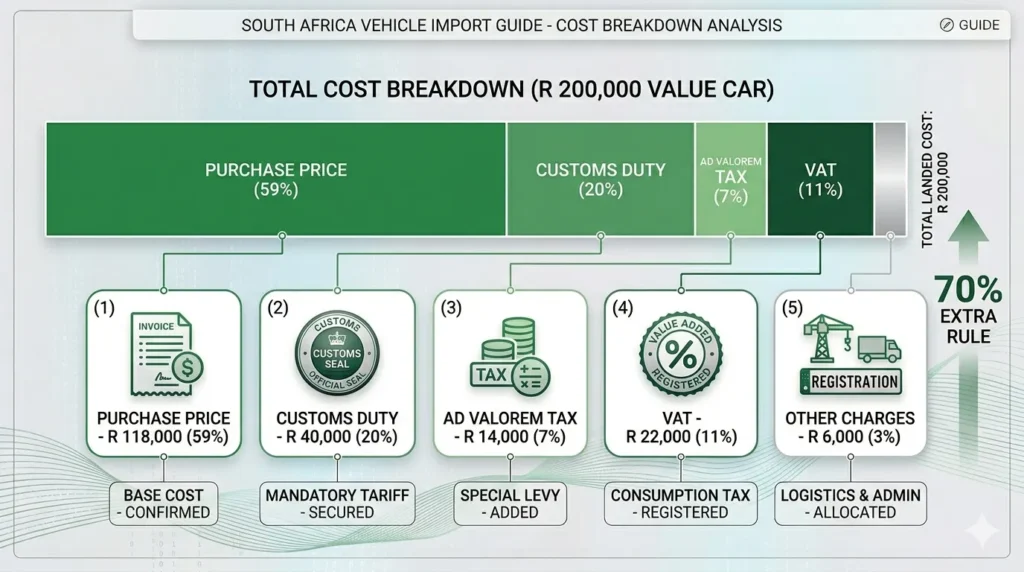
Once your vehicle arrives at port, the South African Revenue Service (SARS) calculates all applicable duties and taxes. Here is the complete breakdown:
1. Customs Duty
- Standard rate: 30% of the vehicle’s customs value
- Vehicles over 20 years old: Reduced to 20%
- The customs value is typically based on the vehicle’s purchase invoice, or if unavailable, three written valuations from Japanese used car exporters
2. Ad Valorem Customs Duty
A sliding scale additional duty based on the vehicle’s value:
| Vehicle Value (ZAR) | Ad Valorem Rate |
|---|---|
| Below R 130,000 | 0% (exempt) |
| R 130,001 – R 200,000 | 0.75% |
| R 200,001 – R 500,000 | Up to 10% |
| Above R 500,000 | Up to 20% |
- Vehicles with a market value below R 130,000 are exempt from ad valorem duty
- The scale rises progressively with vehicle value — luxury and high-value imports attract the highest rates
3. Value Added Tax (VAT)
- Rate: 15%
- Calculated on: CIF value + Customs Duty + additional 10% of that combined value
- Formula:
VAT = 15% × (CIF + Customs Duty + 10% of (CIF + Customs Duty))
4. Total Tax Impact
As an example, the cumulative taxes and duties payable on a vehicle with a market value of approximately R 200,000 are approximately 70% of that market value when all charges are combined.
Full Cost Example Toyota Land Cruiser Prado (2019, 3.0L Diesel)
| Cost Item | Estimated Amount |
|---|---|
| Japan Auction Price | $22,000 (≈ R 400,000) |
| Japan Shipping (RoRo) | $1,200 (≈ R 22,000) |
| Insurance | $300 (≈ R 5,500) |
| CIF Value (Total) | ≈ R 427,500 |
| Customs Duty (30%) | ≈ R 128,250 |
| Ad Valorem Duty (≈8%) | ≈ R 34,200 |
| VAT (15%) | ≈ R 88,500 |
| NRCS LOA Fee | ≈ R 1,800 |
| Port Handling / THC | ≈ R 15,000 |
| Clearing Agent Fee | ≈ R 8,000 |
| Roadworthiness Test | ≈ R 200 |
| Estimated Total in SA | ≈ R 703,000+ |
Note: These are estimates only. Actual SARS assessment depends on the vehicle’s exact customs value, HS code classification, and current tariff schedule.
Duty Exemption Returning Residents & Immigrants
Returning South African residents and bona fide immigrants who meet the strict eligibility criteria may import one vehicle free of customs duty and VAT. On arrival, they must complete SARS Form DA304A to apply for the exemption.
Step-by-Step Process: How to Import a Japanese Car to South Africa
Step 1: Confirm Your Eligibility
Before anything else, verify that you qualify under one of ITAC’s approved categories — returning resident, immigrant, inherited vehicle, or special exemption. This is non-negotiable.
Step 2: Apply for NRCS Letter of Authority (LOA)
Submit Form LA01 to the NRCS with all supporting documents. Pay the application fee (ZAR 300–1,800). Allow at least 5 working days for processing. The LOA confirms the vehicle meets South African compulsory specifications.
Step 3: Apply for ITAC Import Permit (Form IE462)
Submit the completed IE462 form with all required documents to ITAC in Pretoria. ITAC does not charge a service fee, but processing takes several working days. The permit is delivered only to addresses in South Africa.
Step 4: Register as a SARS Importer (Form DA 185)
Complete Form DA 185 at a SARS office or via eFiling to obtain your importer’s code. This is required for customs clearance.
Step 5: Find a Reputable Japanese Car Exporter
Search verified auction houses and exporters in Japan. Trusted platforms include:
- USS Auction (Japan’s largest)
- JAA (Japan Auto Auctions)
- AUCNET
- BE FORWARD, SBT Japan, SAT Japan (South Africa-experienced exporters)
Always request the full auction sheet before bidding. Check for:
- Grade (4 or above is recommended)
- Mileage consistency
- Accident damage markers
- Flood damage notation (look for 冠水 on the auction sheet)
Step 6: Arrange Pre-Shipment Inspection
Obtain a vehicle inspection report from a reputable inspection service. This provides third-party verification of the car’s condition before it leaves Japan.
Step 7: Arrange Shipping (RoRo or Container)
Book through a licensed freight forwarder experienced in Japan–South Africa routes. Obtain the Bill of Lading (B/L) once the vehicle is loaded — this is a critical customs document.
Step 8: Prepare All Import Documents
Gather the complete document set before the ship arrives:
| Document | Purpose |
|---|---|
| Original Bill of Lading (B/L) | Shipping proof — vessel, date, port of loading |
| Japanese Export Certificate | Confirms vehicle ownership and legal export from Japan |
| Commercial Invoice / Purchase Invoice | Establishes customs value |
| NRCS Letter of Authority (LOA) | Safety & spec compliance — MANDATORY |
| ITAC Import Permit (IE462 approval) | Import authorisation — MANDATORY |
| SARS Importer Code (DA 185 approval) | Customs registration |
| Passport (with recent entry/exit stamps) | Identity verification |
| Proof of Overseas Residence | For returning residents/immigrants |
| Permanent Residency Certificate | For immigrants (from Home Affairs) |
| Vehicle Registration Certificate (Japan) | Foreign ownership proof |
| Insurance Certificate | For CIF value calculation |
Step 9: Customs Clearance with SARS
When the vehicle arrives at port, your clearing agent submits a Customs Clearance Declaration (CCD) with all documents. SARS will:
- Review all documentation
- Assess the vehicle’s customs value
- Calculate customs duty, ad valorem duty, and VAT
- Issue a customs assessment
Pay all duties electronically to SARS. Once payment is confirmed, SARS issues the Customs Release Notification — without this, the vehicle cannot leave the port.
If you qualify for the returning resident / immigrant duty and VAT exemption, complete SARS Form DA304A at this stage.
Step 10: Roadworthiness Test
Vehicles over 5 years old require a roadworthiness certificate before registration. The test costs approximately ZAR 200 and checks mechanical safety (brakes, lights, tyres, steering).
Step 11: Register with the Traffic Department
Present the Customs Release Notification and all other documents at your local traffic department office to register the vehicle. You’ll receive:
- South African number plates
- Vehicle registration certificate
- License disc
Step-by-Step Process: How to Import a Japanese Car to South Africa
Mistake 1: Shipping Before Permits Are Secured The LOA and ITAC permit must be secured BEFORE the vehicle is shipped. Many importers make the costly error of buying and shipping first, only to discover their vehicle cannot clear customs. The vehicle then sits at the port accumulating demurrage charges.
Mistake 2: Underestimating Total Import Costs The auction price is only the starting point. When customs duty (30%), ad valorem duty (up to 20%), VAT (15%), shipping, port charges, and clearing fees are added, the total cost can be 60–75% above the original purchase price.
Mistake 3: Relying on Verbal Valuations If the original purchase invoice is not available, SARS requires three written valuations from Japanese used car exporters to determine customs value. Prepare this documentation in advance.
Mistake 4: Ignoring the Auction Sheet Always obtain and verify the full auction sheet translation. Pay special attention to:
- Flood damage (冠水) — vehicles with water damage deteriorate rapidly
- Odometer consistency — compare with vehicle age and grade
- Structural damage markers — check body panels, frame, undercarriage
Mistake 5: Using Unregistered Clearing Agents Only engage a SARS-registered clearing agent for customs clearance. Unregistered agents can cause legal complications, delays, and additional costs.
Mistake 6: Forgetting the 2-Year Disposal Restriction Vehicles imported under ITAC permit cannot be sold or transferred for two years after importation. Planning to sell immediately after import violates permit conditions.
Frequently Asked Questions (FAQs)
Q1: Can anyone in South Africa import a used Japanese car?
No. South African law restricts used vehicle imports to specific categories: returning South African residents, bona fide immigrants, and certain special cases (inherited vehicles, racing cars, vintage vehicles). Commercial importation of used vehicles for resale is not permitted under general import permits.
Q2: What is the total cost of importing a Japanese car to South Africa?
The cumulative taxes and duties alone can reach approximately 70% of the vehicle’s market value. On a R 200,000 vehicle, you could pay an additional R 140,000+ in duties, VAT, and ad valorem charges — before shipping, port, and clearing costs. Always calculate full landed cost before committing to a purchase.
Q3: How long does the Japan to South Africa import process take?
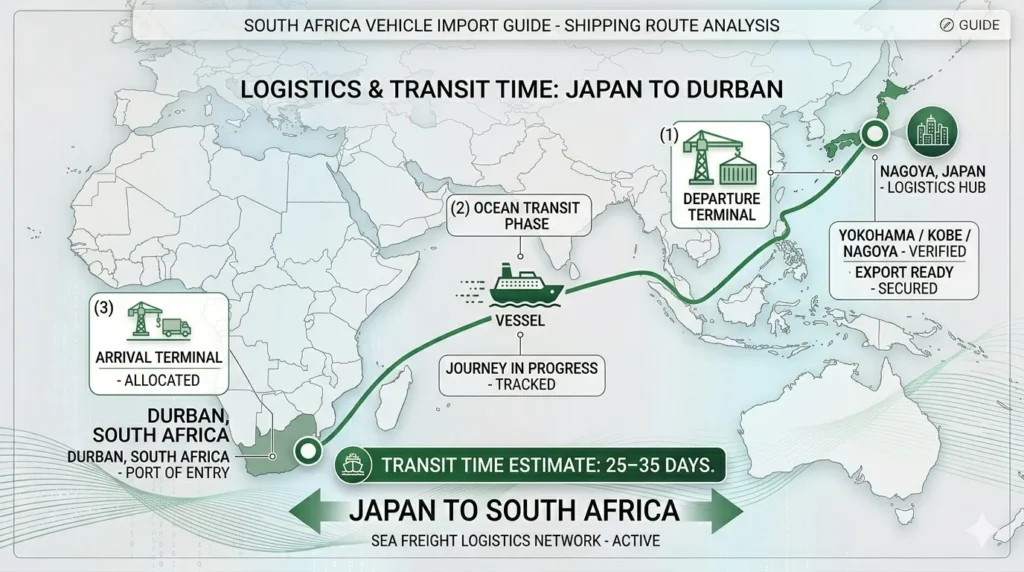
Allow 3–6 months from permit application to having a registered vehicle. Permit processing (NRCS + ITAC) alone can take several weeks. Shipping from Japan to Durban takes 25–35 days. Customs clearance adds another 1–3 weeks. Registration follows thereafter.
Q4: What is the NRCS Letter of Authority and why is it mandatory?
The NRCS (National Regulator for Compulsory Specifications) Letter of Authority certifies that the imported vehicle meets South Africa’s compulsory safety, technical, and environmental standards. Without the LOA, the vehicle cannot be registered for road use in South Africa regardless of whether all customs duties have been paid.
Q5: Are vehicles over 20 years old charged lower duty?
Yes. Motor vehicles over 20 years old are subject to a reduced customs duty rate of 20%, compared to the standard 30% for newer vehicles. Combined with possible ad valorem exemptions on lower-value vehicles, classic/vintage cars can sometimes attract lower overall duty.
Q6: Can returning South Africans import a car duty-free?
Yes, if you qualify. Returning South African residents who are permanently changing their residency back to South Africa, and who have owned and registered the vehicle in their name for at least 12 months abroad, may import one vehicle free of customs duty and VAT. Form DA304A must be completed at SARS customs upon arrival.
Q7: What happens if I import without an ITAC permit?
Importing a used vehicle without a valid ITAC import permit is illegal under the International Trade Administration Act (No. 71 of 2002). Your vehicle can be seized at the port, and you face significant fines and potential legal action. There is no “fixing it later” permits must be obtained before shipment.
Disclaimer
This guide is for informational purposes only and reflects regulations and duty structures as understood in 2025. South Africa’s import regulations, SARS tariff schedules, and ITAC permit policies are subject to change. Always consult a SARS-registered clearing agent or a licensed customs broker before committing to any vehicle purchase or shipment. Final duty assessment is determined by SARS at the time of customs clearance.
© 2026 [Buy Car From Japan Guide] | Import Japanese Cars to South Africa — Complete Guide
