 Skip to content
Complete Guide
Japanese Car Japan To Kenya 🇰🇪
Import Japanese Cars to Kenya Complete 2026 Guide | KRA Duty, KEBS Rules & Full Process
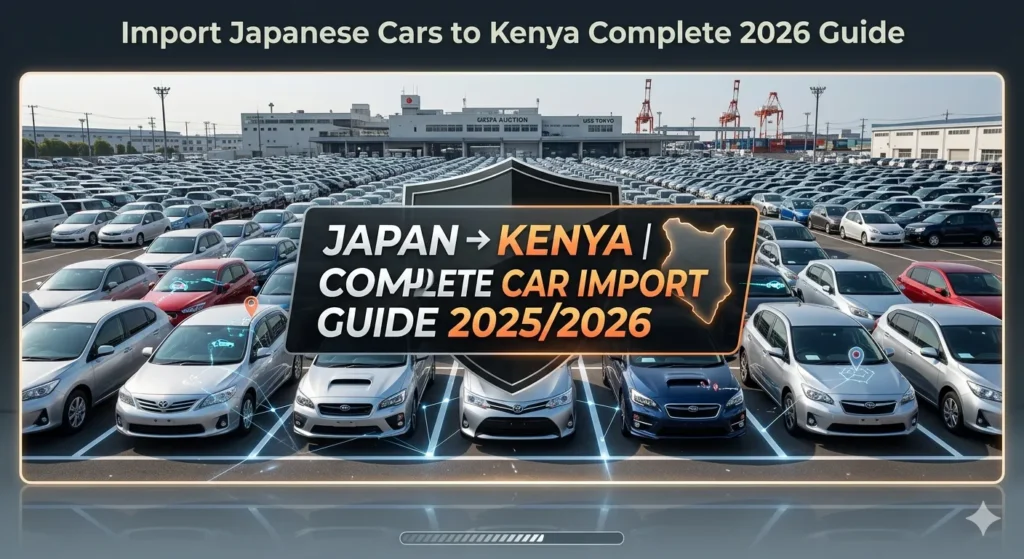
Kenya is East Africa’s largest importer of Japanese used vehicles. Walk through any town from Nairobi’s Ngong Road to Mombasa’s Nyali and you’ll find streets filled with Toyota Premio sedans, Corolla Fielder estates, Subaru Foresters, and Land Cruiser Prados all sourced from Japan’s deep and transparent used car market.
Importing a Japanese car to Kenya gives buyers access to low-mileage, well-maintained vehicles at prices far below equivalent locally assembled options. But the process involves multiple government agencies, strict compliance requirements, and recent regulatory changes that every importer must understand before spending a single shilling.
This guide covers every step, every cost, and every document including the critical January 2026 KEBS age-limit rule and the July 2025 KRA CRSP duty update so you arrive at Mombasa Port fully prepared.
Why Kenyans Choose Japanese Cars
Kenya’s car market runs on Japanese imports — and for very clear reasons:
Right-Hand Drive Compatibility Kenya drives on the left side of the road, just like Japan. Every JDM (Japanese Domestic Market) vehicle is Right Hand Drive (RHD) by default — no modifications needed. This is a natural advantage that makes Japan the perfect source market for Kenyan buyers.
Exceptional Reliability Japanese cars built for domestic use go through Japan’s famously strict annual vehicle inspection system (Shaken — 車検). Cars must meet high mechanical standards every two years, meaning used JDM cars exported to Kenya are often in better condition than their mileage suggests.
Genuine Low Mileage Japanese cities are dense, train and metro systems are excellent, and driving distances are short. A 5-year-old car in Japan may have covered only 40,000–60,000 km — far less than a comparable UK or US vehicle.
Transparent Grading System Every car sold through Japanese auctions carries a detailed auction sheet — an official inspection report graded from 1 (poor) to 6 (immaculate) that documents mileage, paint condition, accident history, and specific damage points. Kenyan buyers can verify exactly what they’re getting.
Strong Parts Availability Toyota, Nissan, Honda, Subaru, and Mazda all have established dealer and aftermarket networks in Kenya. Parts for popular JDM models like the Toyota Premio, Corolla Fielder, and Subaru Forester are widely stocked across Nairobi and major towns.
Value for Money For the equivalent price of a low-specification locally assembled entry-level car, a Kenyan buyer can import a well-equipped Japanese vehicle with features like leather seats, backup camera, and automatic climate control.

Most Popular Japanese Cars Imported to Kenya
These are the top JDM models consistently in demand among Kenyan buyers:
Toyota Premio Kenya’s Favourite Sedan
The Toyota Premio is arguably Kenya’s most beloved imported sedan. Known for its executive styling, whisper-quiet cabin, and rock-solid 1NZ-FE and 2AZ-FE engines, the Premio appeals to professionals, executives, and families who want comfort at a reasonable price point.
- Why it’s popular: Premium interior feel, strong resale value, widely serviced across Kenya
- Typical specs: 1500cc or 2000cc, automatic, 2018–2022 models
- Best for: Professionals, family sedan, personal use
- Availability on Jiji.co.ke: Hundreds of active listings
Toyota Corolla Fielder (Wagon / Estate)
The Corolla Fielder is a practical estate version of the Corolla with excellent boot space, making it a favourite for families and small businesses. The WXB grade with its premium interior is especially popular.
- Why it’s popular: Practicality, fuel efficiency, boot space, Toyota reliability
- Typical specs: 1500cc or 1800cc NZE/ZRE engine, 2019–2022
- Best for: Families, school runs, light cargo, upcountry travel
Toyota Corolla Axio
The compact four-door version of the Corolla. Slightly smaller than the Premio but equally reliable, the Axio is popular among younger buyers and those commuting in Nairobi’s traffic.
- Why it’s popular: Fuel-efficient, easy to park, affordable to maintain
- Typical specs: 1500cc NZE engine, automatic, 2019 onwards
- Best for: Urban commuting, first car, taxi/PSV operators
Toyota Harrier The Aspirational SUV
The Toyota Harrier is Kenya’s status SUV from Japan. Its premium cabin equivalent to a Lexus RX in quality combined with Toyota reliability makes it the choice vehicle for Nairobi’s aspirational upper-middle class.
- Why it’s popular: Premium brand perception, comfort, fuel-efficient 2.0L engine
- Typical specs: 2000cc turbo or 2500cc hybrid, 2019–2022
- Best for: Nairobi executive commuting, family SUV
Toyota Land Cruiser Prado
The Land Cruiser Prado is king in Kenya for safari operators, government agencies, NGOs, and buyers who need serious off-road capability combined with premium comfort.
- Why it’s popular: Off-road legend, prestige, legendary engine durability
- Typical specs: 2700cc 4-cylinder or 3000cc diesel, 150 Series
- Best for: Safari, upcountry, NGO/government, high-net-worth buyers
Toyota Hilux
Kenya’s workhorse pickup truck. The Hilux dominates the commercial sector from flower farms in Nakuru to construction sites in Kisumu thanks to its payload capacity and bulletproof GD-series diesel engines.
- Why it’s popular: Payload capacity, diesel reliability, resale value
- Typical specs: 2800cc GD-6 turbodiesel, double cab or single cab
- Best for: Farming, construction, cargo, fleet use
Toyota Noah / Voxy
Seven to eight-seater minivans that offer space-efficient family transport. The Noah and Voxy are popular for large families, school transport, and informal shuttle operators.
- Why it’s popular: 7-8 seats, sliding doors, space efficiency
- Best for: Large families, school transport, informal PSV
Subaru Forester
Kenya’s favourite Japanese SUV outside the Toyota range. Subaru’s symmetrical AWD system and horizontally-opposed Boxer engine are particularly valued in Kenya’s hilly terrain and wet-season roads.
- Why it’s popular: AWD reliability, ground clearance, driving dynamics
- Typical specs: 2000cc FB20 or EJ20 engine
- Best for: Upcountry, highlands, adventure driving
Honda Fit (Jazz)
A compact hatchback with a surprisingly spacious interior and excellent fuel economy. The Honda Fit is popular among urban buyers who prioritise running costs over size.
- Why it’s popular: Fuel efficiency, compact size, easy to park, low maintenance
- Best for: Nairobi city driving, students, young professionals
Mazda Demio / Mazda 2
Another compact hatchback choice popular among cost-conscious buyers. The Demio’s SKYACTIV engine delivers strong fuel economy for its class.
- Why it’s popular: Fuel efficiency, sporty feel, affordable price
- Best for: Urban commuting, budget-conscious buyers

Critical 2026 Regulation Update 8-Year Age Limit & KEBS New Rules
Before you look at a single car listing, you must understand Kenya’s age limit and the new January 2026 KEBS rules.
KEBS January 2026 Update (Critical)
In November 2025, the Kenya Bureau of Standards (KEBS) issued new directives. Effective January 1, 2026:
- Only RHD vehicles first registered from January 1, 2019 and later will be allowed into Kenya
- This enforces the existing 8-year age limit under KS 1515:2000
- KEBS has engaged Japanese company QISJ to verify import documents at the destination
- Importers must pay a QISJ validation fee of KSh 12,000 per vehicle at local offices
- Validation service timeline: 4 working days
What this means in practice for 2026:
- If you are importing in 2026, your car must have been first registered in 2019 or later
- The 8-year limit is calculated from the year of manufacture, not registration year
- Vehicles older than 8 years cannot be cleared at Kenyan ports
KRA CRSP July 2025 Update (Critical)
From July 1, 2025, KRA implemented a new Current Retail Selling Price (CRSP) schedule for used vehicle valuation:
- CRSP database expanded from ~3,000 to over 5,200 vehicle models
- Import duty rate increased from 25% to 35% (significant change)
- Excise duty now ranges from 20% to 35% depending on engine size and vehicle type
- VAT remains at 16% (but applied on higher base values)
- Exchange rate benchmark updated to KES 130 per USD (from KES 100 in 2019)
These changes mean that vehicles imported after July 2025 are significantly more expensive to clear than the same vehicle imported before the CRSP revision.
KRA Import Duty & Tax Structure Complete Breakdown 2025
All duties are calculated based on the CRSP (Current Retail Selling Price) KRA’s official benchmark value for each vehicle model. KRA uses the higher of the declared invoice price or the CRSP value.
Step 1: Depreciation Applied to CRSP
KRA reduces the CRSP value based on vehicle age:
| Vehicle Age | Depreciation Rate |
|---|---|
| Less than 1 year | 5% |
| 1 to 2 years | 10% |
| 2 to 3 years | 15% |
| 3 to 4 years | 20% |
| 4 to 5 years | 30% |
| 5 to 6 years | 40% |
| 6 to 7 years | 50% |
| 7 to 8 years (maximum) | 65% (cap) |
Customs Value = CRSP minus Depreciation
Step 2: All Taxes & Levies Applied
| Tax / Levy | Rate | Calculated On |
|---|---|---|
| Import Duty | 35% (from July 2025) | Customs Value (CIF) |
| Excise Duty | 20% – 35% (engine/type dependent) | Customs Value + Import Duty |
| Value Added Tax (VAT) | 16% | CIF + Import Duty + Excise Duty |
| Import Declaration Fee (IDF) | 2.5% | Customs Value |
| Railway Development Levy (RDL) | 2% | Customs Value |
Excise Duty Rates by Engine Capacity
Excise Duty Rates by Engine Capacity
| Engine Capacity | Excise Duty Rate |
|---|---|
| Up to 1500cc (petrol) | 20% |
| 1500cc – 3000cc (petrol) | 25–30% |
| Above 3000cc | 35% |
| Diesel vehicles | 25–35% |
| Hybrid vehicles | Reduced rate (15–20%) |
| Electric vehicles (BEV) | 10% (preferential) |
Port of Mombasa Clearance Charges
On top of KRA duties, you pay the following at Mombasa Port:
| Charge | Amount (KSh) |
|---|---|
| Port charge & SGR levy | 120,000 |
| QISJ verification fee | 15,000 |
| Interpol check | 15,000 |
| MSS levy | 2,000 |
| Radiation check | Variable |
| Clearing agent fee | 30,000 – 80,000 |
| Local transport (Mombasa–Nairobi) | 20,000 – 50,000 |
| NTSA registration fee | 10,000 – 25,000 |
Full Cost Example Toyota Premio 2020 (1500cc, Petrol)
| Cost Item | Amount |
|---|---|
| Japan Auction Price | $6,000 (≈ KSh 780,000) |
| Shipping Japan to Mombasa (RoRo) | $900 (≈ KSh 117,000) |
| Marine Insurance | $150 (≈ KSh 19,500) |
| CIF / Customs Value | ≈ KSh 916,500 |
| KRA CRSP (Premio 2020 approx.) | ≈ KSh 2,200,000 |
| Depreciation 30% (5 yr old in 2025) | −KSh 660,000 |
| Taxable Customs Value | ≈ KSh 1,540,000 |
| Import Duty 35% | ≈ KSh 539,000 |
| Excise Duty 20% | ≈ KSh 415,800 |
| VAT 16% | ≈ KSh 399,168 |
| IDF 2.5% | ≈ KSh 38,500 |
| RDL 2% | ≈ KSh 30,800 |
| Total KRA Taxes | ≈ KSh 1,423,268 |
| Port charges (Mombasa) | ≈ KSh 160,000 |
| Clearing agent | ≈ KSh 50,000 |
| Transport to Nairobi | ≈ KSh 30,000 |
| NTSA registration | ≈ KSh 15,000 |
| TOTAL COST IN KENYA | ≈ KSh 3,374,000 |
Note: CRSP values and depreciation schedules are subject to KRA updates. Use KRA’s official calculator at kra.go.ke for the most current assessment.
Duty-Free Import Returning Residents
Returning Kenyan residents may import one vehicle duty-free under specific conditions. This is one of the most significant savings available to eligible importers.
Eligibility Criteria
- Must have been residing outside Kenya for at least 2 years continuously
- Must not have visited Kenya for an average of more than 90 days per year during that period
- The vehicle must have been owned and used by the importer for at least 1 year abroad
- An authentic foreign vehicle logbook is mandatory — certificates from Dubai police or similar substitutes are NOT accepted by KRA
- If the logbook is in a foreign language, an English translation must be provided by the relevant embassy, High Commission, or consulate based in Kenya
- An Import Declaration Fee (IDF) is still payable (minimum $5,000 or 2.25% of CIF — whichever is greater)
This exemption can save returning residents KSh 1–3 million depending on the vehicle, making it one of the most valuable import benefits available.
Mandatory Compliance Requirements What Every Car Must Have
1. 8-Year Age Limit (KEBS)
The vehicle must be less than 8 years old from the year of manufacture. In 2026, vehicles must be 2019 or newer. This is strictly enforced by KEBS and KRA.
2. Right-Hand Drive (RHD) Only
Only RHD vehicles are permitted. Left-hand drive cars are not allowed except for specific exempt categories (ambulances, fire trucks). Japan is naturally RHD — this requirement is automatically met for all JDM vehicles.
3. JEVIC / QISJ Pre-Shipment Inspection
Every vehicle must undergo a pre-export inspection by a KEBS-approved inspection body in Japan before shipment. The two approved agencies are:
- JEVIC (Japan Export Vehicle Inspection Centre) — long-established KEBS-approved inspector
- QISJ — now also engaged for destination verification in Kenya (KSh 12,000 fee)
Without a valid JEVIC/QISJ certificate, the vehicle cannot clear Kenyan customs. Importing without this certificate attracts a 15% penalty on import duty.
4. Certificate of Roadworthiness (CoR)
A Certificate of Roadworthiness issued by KEBS after inspection is required for customs clearance. This checks brakes, lights, steering, tyres, and emissions.
5. KS 1515:2000 Compliance
Vehicles must comply with Kenya’s Standard Code of Practice for Inspection of Road Vehicles (KS 1515:2000) covering safety and environmental standards.
6. Authentic Logbook
An original, authentic vehicle logbook from the country of export is required. KRA specifically states that substitute documents from Dubai authorities are not accepted.

Shipping: Japan to Kenya Ports, Methods & Transit Times
Kenyan Entry Port
- Port of Mombasa — Kenya’s main international seaport and the primary entry point for all vehicle imports. Clearing happens at Mombasa before transport to Nairobi or upcountry.
- Malaba Border — For vehicles brought overland from Uganda (rare)
Shipping Methods
RoRo (Roll-on Roll-off) — Most Popular The standard method for importing cars from Japan. Vehicles are driven onto a purpose-built ship in Japan and driven off at Mombasa.
- Transit time: 21–28 days (Japan to Mombasa)
- Cost: $700 – $1,200 per vehicle
- Best for: Standard sedans, SUVs, pickups
Container Shipping (20ft) One car in a dedicated container — more expensive but provides full protection during transit.
- Transit time: 25–35 days
- Cost: $1,200 – $2,500
- Best for: High-value, luxury, or classic vehicles
Major Japan Export Ports for Kenya-Bound Vehicles
- Port of Nagoya — Japan’s largest automotive export hub
- Port of Osaka / Namba
- Port of Yokohama
- Port of Kobe
Step-by-Step Process: How to Import a Japanese Car to Kenya
Step 1: Verify Eligibility & Research Your Budget
Confirm the vehicle you want meets KEBS requirements 2019 or newer, RHD, within your budget after duties. Use the KRA CRSP calculator at kra.go.ke to estimate total duty before committing.
Step 2: Find a Reputable Japanese Exporter / Auction Agent
Work with a verified auction house or export agent in Japan experienced in Kenya exports. Trusted platforms:
- USS Auction (Japan’s largest — thousands of daily listings)
- JAA (Japan Auto Auctions)
- AUCNET
- BE FORWARD (Kenya-experienced)
- SBT Japan (major Kenya exporter)
- Car From Japan (popular with Kenyan buyers)
- CarImports254.co.ke (Kenya-based sourcing agent)
Step 3: Review the Auction Sheet Carefully
Request the full auction sheet translation. Check:
- Grade: Look for Grade 4 or higher (1 = poor, 6 = perfect)
- Mileage: Verify against age and grade
- Accident markers: Check for A (accident), U (underbody damage), W (wavy panels)
- Flood damage: Look for 冠水 (water submersion) — avoid all flood-damaged vehicles
- Interior/exterior condition codes
Step 4: Arrange Pre-Shipment JEVIC Inspection (Mandatory)
Before the car leaves Japan, arrange a JEVIC or QISJ pre-export inspection. This produces:
- Pre-Export Verification of Conformity (PVoC) certificate
- Certificate of Roadworthiness (CoR)
- Inspection fee: $150 – $250
Without this, you face a 15% penalty on import duty at Mombasa.
Step 5: Make Payment to Japanese Exporter
Most Kenya-experienced exporters use a split payment structure:
- 50% at purchase confirmation (to initiate bidding or reserve)
- 50% before vessel arrival (once soft copy documents are shared)
Pay only to verified exporters with track records. Use bank wire transfer with proper documentation.
Step 6: Arrange Marine Insurance
Purchase marine insurance for the vehicle’s transit from Japan to Mombasa. This protects against damage or loss during shipping and is required for CIF calculation.
Step 7: Collect Your Shipping Documents
Once the vehicle is loaded, the exporter provides:
| Document | Purpose |
|---|---|
| Original Bill of Lading (B/L) | Primary shipping proof — vessel name, loading port, destination |
| Export Certificate (deregistration) | Confirms vehicle legally deregistered in Japan |
| Import Declaration Form (IDF) | KRA primary import document |
| JEVIC / QISJ Inspection Certificate | KEBS compliance — MANDATORY |
| Certificate of Roadworthiness (CoR) | Safety compliance |
| Original Vehicle Logbook | Foreign ownership proof |
| Commercial Invoice | Customs value evidence |
| Packing List | Shipment details |
| Marine Insurance Certificate | Transit protection proof |
Step 8: Submit IDF to KRA (Import Declaration Form)
The Import Declaration Form (IDF) must be submitted to KRA through the Kenya TradeNet system before the vessel arrives. Any errors or mismatches in the IDF result in delays and additional charges. Work with a KRA-licensed clearing agent.
Step 9: QISJ Destination Verification (New — January 2026)
From January 2026, importers must have KEBS’s appointed agent QISJ verify the import documents at their local offices in Kenya after arrival.
- Fee: KSh 12,000 per vehicle
- Timeline: 4 working days
Step 10: KRA Customs Clearance at Mombasa
Your licensed clearing agent handles customs at Mombasa Port:
- Submit all documents to KRA
- KRA inspects documents and vehicle
- KRA calculates duties based on CRSP 2025 rates
- Pay all duties electronically (import duty + excise + VAT + IDF + RDL)
- Pay port charges (SGR levy, verification, Interpol, MSS, radiation)
- KRA issues the Release Order and Gate Pass
- Vehicle can now leave the port
Step 11: NTSA Registration (Nairobi or County Office)
Present the Release Order and all customs documents at the National Transport and Safety Authority (NTSA) to register the vehicle:
- Issue Kenyan number plates
- Issue vehicle registration certificate (logbook)
- Pay registration fee (KSh 10,000 – 25,000)
Step 12: Final KEBS Roadworthiness Inspection
A final inspection by KEBS evaluates the vehicle’s mechanical safety — brakes, lights, tyres, steering, exhaust emissions. This is required before the car can legally be driven on Kenyan roads.

Common Mistakes Kenyan Importers Make — And How to Avoid Them
Mistake 1: Buying a Car That Exceeds the 8-Year Age Limit The most costly error. Buying a 2016 vehicle in 2026 means it cannot be cleared at Mombasa Port. It will be rejected, and you face storage fees, re-export costs, or outright loss. Always verify the manufacture year before bidding.
Mistake 2: Using the Declared Invoice Price Instead of CRSP KRA uses whichever is higher your invoice price or the KRA CRSP benchmark. Many importers assume a low invoice price reduces duty. KRA’s CRSP database now covers over 5,200 models — your vehicle is almost certainly in it.
Mistake 3: Skipping JEVIC Inspection Some importers try to skip the pre-shipment inspection to save $150–$250. The penalty is 15% additional import duty potentially KSh 200,000 or more on a typical vehicle. The inspection fee is always worth paying.
Mistake 4: Ignoring Flood Damage on the Auction Sheet Water-damaged vehicles (marked 冠水 on the auction sheet) look fine initially but deteriorate rapidly in wiring, ECU, and rust. Always check the flood damage notation — never buy a flood-damaged car regardless of the price.
Mistake 5: Underestimating Total Landed Cost The auction price is only the starting point. After shipping, CRSP-based KRA duties (which can exceed the actual vehicle purchase price), port charges, clearing fees, and registration, the total landed cost can be 150–200% of the auction price. Always calculate full cost before bidding.
Mistake 6: Using an Unlicensed Clearing Agent Only KRA-licensed clearing and forwarding agents should handle your customs clearance. Unlicensed agents cause delays, incorrect duty assessments, and legal complications that can cost far more than their apparent fee savings.
Mistake 7: Accepting Substitute Logbook Documents KRA specifically rejects certificates from Dubai police or other substitute documents in place of an authentic foreign vehicle logbook. If the logbook is in Japanese, get a certified English translation from the Kenyan embassy or High Commission in Japan.
Frequently Asked Questions (FAQs)
Q1: How old can a car be to import to Kenya in 2026?
From January 1, 2026, only vehicles first registered in 2019 or later are allowed into Kenya. This enforces the 8-year age limit under KEBS rules (KS 1515:2000). The age limit is calculated from the year of manufacture, not the registration date. Vehicles older than 8 years cannot be cleared at Kenyan ports.
Q2: What are the KRA import duties on a Japanese car?
Under the July 2025 CRSP update, the main taxes are: Import Duty 35%, Excise Duty 20–35% (depending on engine size and fuel type), and VAT 16% — all calculated on the depreciated CRSP value. Plus IDF (2.5%) and RDL (2%). On a typical mid-range vehicle, total KRA taxes can range from KSh 800,000 to KSh 2,000,000+.
Q3: What is CRSP and how does it affect my import duty?
CRSP (Current Retail Selling Price) is the KRA’s official benchmark price for each vehicle model in its country of origin. KRA uses the higher of the declared invoice price or the CRSP value to calculate duties. The 2025 CRSP update covers over 5,200 models and applies higher duty rates than the previous 2019 schedule.
Q4: Is JEVIC inspection mandatory for importing to Kenya?
Yes. Every vehicle imported to Kenya must have a pre-export inspection by a KEBS-approved agency either JEVIC or QISJ before leaving Japan. Without this certificate, you face a 15% penalty on import duty at Mombasa customs. The inspection costs $150–$250 and is always worth paying.
Q5: Can I import a car duty-free as a returning resident?
Yes, if you qualify. Returning Kenyan residents who have lived outside Kenya for at least 2 years continuously, not visiting Kenya for more than 90 days per year on average, and who have owned the vehicle for at least 1 year abroad, may import one vehicle duty-free. An IDF is still payable ($5,000 or 2.25% of CIF — whichever is greater). An authentic original foreign logbook is mandatory.
Q6: How long does the import process take from Japan to Kenya?
Allow 2–4 months from vehicle purchase to NTSA registration. RoRo shipping from Japan takes 21–28 days. KRA customs clearance at Mombasa takes 1–3 weeks. QISJ validation (January 2026) adds 4 working days. NTSA registration follows after clearance.
Q7: What is the QISJ validation fee and why is it required?
From January 2026, KEBS appointed QISJ to verify import documents at destination to curb fraud and confirm compliance with Kenya’s 8-year age limit. The fee is KSh 12,000 per vehicle paid at local QISJ offices, with a 4 working day turnaround.
Q7: What is the QISJ validation fee and why is it required?
This guide is for informational and educational purposes only. KRA duty rates, KEBS regulations, CRSP values, and import policies are subject to change without notice. All costs shown are estimates only — actual KRA assessment depends on the specific vehicle’s CRSP value, age, engine capacity, fuel type, and current tariff schedules. Always consult a KRA-licensed clearing agent and verify current regulations at kra.go.ke and kebs.org before committing to any vehicle purchase or shipment.
Sources: Kenya Revenue Authority (kra.go.ke), Kenya Bureau of Standards (kebs.org), NTSA, AutoMag.co.ke, Eleven Motors Kenya, CarLuv.co.uk, MHH International, CarImports254.co.ke, QISJ Kenya directive November 2025
