 Skip to content
Complete Guide
Japanese Car Japan to Trinidad & Tobago 🇹🇹
Japanese Car Japan to Trinidad & Tobago: The Ultimate 2026 Import Guide
Importing a high-quality, fuel-efficient Japanese car from Japan to Trinidad & Tobago is an exceptionally smart path for local drivers to secure a reliable vehicle while avoiding massive dealership markups. Sourcing directly from Japanese auction houses grants you access to clean vehicle histories, pristine maintenance standards, and highly competitive prices. From compact hybrid hatchbacks to modern family crossovers, buying direct is the preferred choice for thousands of Trinbagonians.
However, Trinidad maintains an incredibly strict, highly policed automotive entry framework. Sourcing a vehicle without understanding the exact build date rules, trade licensing windows, and multi-tiered tax compounding structures can cause massive financial loss or result in your car being sent back to Asia.
Before placing any bids on auction lots, we highly recommend opening our real-time Japanese Car Trinidad Import Duty Calculator to get an instant landed cost projection tailored to your budget.
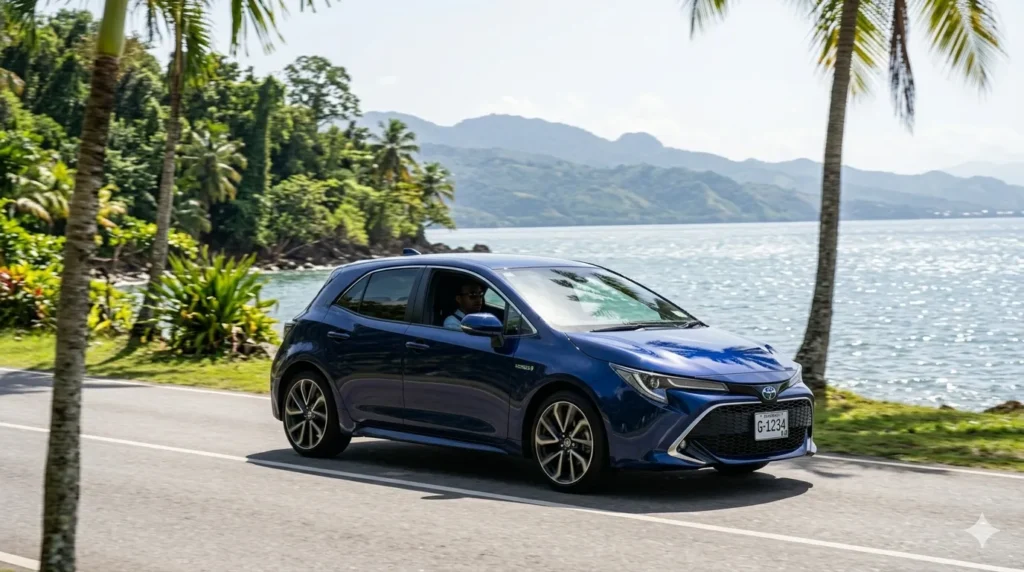
Is It Legal to Import a Car from Japan to Trinidad & Tobago?
Yes, importing a car from Japan to Trinidad & Tobago is entirely legal, provided you follow the strict regulatory guidelines enforced at the national borders. This entire trade corridor is managed and patrolled directly by the Customs and Excise Division along with the Trade Licence Unit (TLU) of the Ministry of Trade and Industry.
Private individuals are legally allowed to import one vehicle for personal use every three years. Crucially, you must obtain an official Import License before your vehicle departs the shipping ports in Japan. Sourcing a car and letting it sail without this pre-approved license is an illegal border entry offense, resulting in compulsory re-exportation or immediate vehicle forfeiture.
Trinidad-Specific Steering & Traffic Rule
Trinidad & Tobago follows left-side traffic patterns, which requires specific vehicle configurations to ensure optimal visibility on busy two-lane roads. Because of this, Right-Hand Drive (RHD) configurations are strictly mandatory for all private and commercial passenger imports.
Left-Hand Drive (LHD) civilian vehicle configurations are completely illegal to import or register for public road use. This rule makes Japanese domestic market vehicles an ideal match, as Japan is also natively an RHD nation. When you buy direct from Tokyo or Nagoya, the steering and safety alignments naturally match local driving laws perfectly.
Vehicle Eligibility Requirements for Trinidad & Tobago
Trinidad’s customs enforcement monitors entry standards closely to prevent the country from becoming a dumping ground for older or structurally damaged vehicles. Failing to verify production windows can easily lead to border clearance issues.
The 2026 Compliance Checklist
Maximum Vehicle Age: Maximum 4 years old from the year of manufacture for private passenger cars (Sedans, SUVs, Hatchbacks). In 2026, standard cars must be 2022 or newer.
Commercial Vehicle Age Limits: Pickups, panel vans, and light trucks are allowed up to 5 years old (2021 or newer).
Steering Configuration: Right-Hand Drive (RHD) only. Left-Hand Drive is strictly banned.
Diesel Engine Restrictions: Generally restricted for private passenger cars unless imported under specialized commercial classifications or heavy duty trucks.
Hybrid Vehicles: Allowed up to 4 years old. Engine sizes below 1599cc enjoy complete exemption from customs duty, motor vehicle tax, and VAT.
Electric Vehicles (EVs): Allowed up to 4 years old. Vehicles with powertrain outputs under 179 kilowatts enjoy absolute tax-free entry (0% Duty, 0% MVT, 0% VAT).
Banned vehicle histories: Vehicles bearing a salvage certificate, water-damaged history, or major chassis reconstruction records are strictly barred from customs entry.
The Import Sweet Spot: The absolute ideal import for Trinidad is a 2022 or 2023 manufacture year Hybrid vehicle under 1599cc (such as a Toyota Aqua or Honda Fit). Sourcing within this range satisfies the strict 4-year age limit, capitalizes on early Japanese depreciation, and unlocks complete tax exemptions, giving you a nearly new car for a fraction of local retail prices.
CRITICAL WARNING: Never look at the “first registration date” on Japanese dealer sheets. Trinidad Customs calculates vehicle age strictly by the physical manufacture date embedded in the chassis number. Always check the production log before sending a bank wire transfer.
PRO TIP: If you are a registered farmer, you can apply directly to the Ministry of Agriculture for a Special Commercial Concession, which allows you to import a Japanese four-wheel-drive pickup truck with a 100% exemption from all customs duties.
Want to confirm if your target model satisfies the strict 4-year age limit? Input your chassis details into our Automated Trinidad Eligibility Tool for instant validation.
Shipping from Japan to Trinidad & Tobago Ports, Methods & Cost
Getting your vehicle safely across oceans requires reliable shipping lanes. Most cargo ships departing Japan leave from primary commercial ports like Yokohama, Nagoya, Kobe, and Osaka.
Primary Destination Ports: Port of Port of Spain and Port of Point Lisas.
Average Transit Time: 45 to 60 days, depending on route staging and carrier lines.
Special Shipping Route Note: Vessels travel east across the Pacific Ocean, transit directly through the Panama Canal, and enter the Caribbean Sea to unload at Trinidadian ports.
Maritime Freight Logistics Comparison
| Shipping Method | Estimated Cost (USD) | Average Transit Time | Best For |
| Roll-On / Roll-Off (RoRo) | $1,100 – $1,500 | 45 – 55 Days | Standard sedans, compact hatchbacks, and everyday family SUVs. |
| Container Shipping (20ft / 40ft) | $2,800 – $4,200 | 50 – 60 Days | Premium sports cars, high-end luxury models, or multi-car commercial lots. |
PRO TIP: Roll-On/Roll-Off (RoRo) shipping is by far the most economical choice for Port of Spain delivery. It costs thousands less than container freight, and because vehicles are driven onto specialized internal decks away from elements, port discharge is highly efficient.
WARNING: The Atlantic hurricane season runs from June 1st through November 30th. Extreme tropical weather can occasionally disrupt vessel tracks or delay passage through the Panama Canal. Always verify that your exporter includes comprehensive marine insurance.
To run a precise freight quote matching your vehicle’s physical dimensions, try our Landed Shipping Cost Estimator.
Import Duty & Full Tax Breakdown for Trinidad & Tobago
Trinidad utilizes a multi-tiered, compounding tax structure. Taxes are calculated directly on the total CIF Value (Vehicle Purchase Cost + Marine Insurance + Ocean Shipping Freight fees). However, if your vehicle matches the country’s clean-energy incentives, you can save significantly.
Full Financial Assessment (Based on an $8,000 FOB Petrol Car, 1500cc)
| Cost Element | Calculation Basis / Rate | Total Amount (USD) | Total Amount (TTD) |
| FOB Vehicle Purchase Price | Base Japanese Auction Sourcing Cost | $8,000.00 | $54,400.00 |
| Ocean Freight Shipping | RoRo Route via Panama Canal | $1,300.00 | $8,840.00 |
| Marine Insurance | Standard 1% Transit Valuation Protection | $80.00 | $544.00 |
| Total CIF Value | Base FOB + Freight + Marine Insurance | $9,380.00 | $63,784.00 |
| Import Duty | 20% of Total CIF Value | $1,876.00 | $12,756.80 |
| Motor Vehicle Tax (MVT) | Fixed rate based on 1500cc gas engine | $1,125.00 | $7,650.00 |
| Subtotal for VAT Base | CIF + Import Duty + Motor Vehicle Tax | $12,381.00 | $84,190.80 |
| Value Added Tax (VAT) | 12.5% (Calculated on the Compounded Subtotal) | $1,547.63 | $10,523.85 |
| Port Handling Fees | Fixed Port Authority of T&T charges | $120.00 | $816.00 |
| Customs Broker Fee | Local brokerage submission service | $250.00 | $1,700.00 |
| TOTAL LANDED COST | All-Inclusive Price to Clear Vehicle | $14,298.63 | $97,230.65 |
Clean Energy Tax Exemptions
To encourage green energy adoption, the Government of Trinidad & Tobago offers massive tax exemptions for qualified Electric and Hybrid models under 4 years old.
| Propulsion Technology Type | Engine/Output Spec | Customs Duty | Motor Vehicle Tax | VAT Rate |
| Standard Petrol / Diesel | Any Engine Size | 20% to 30% | Scales by CC | 12.5% |
| Hybrid Vehicles | Under 1599cc | 0% (Exempt) | 0% (Exempt) | 0% (Exempt) |
| Electric Vehicles (EVs) | Under 179 kW | 0% (Exempt) | 0% (Exempt) | 0% (Exempt) |
VALUATION ASSESSMENT WARNING: Never present deflated or altered invoices to customs authorities. The Customs and Excise Division cross-references all declared entries with live export logs from Japan using the ASYCUDA electronic system. Attempting to undervalue an entry will result in heavy fines, vehicle seizure, and costly port storage penalties.
Avoid manual calculation errors by running your target vehicle specs through our automated Trinidad Customs Tax Calculator.
Step-by-Step Import Process Japan to Trinidad & Tobago
Importing a car involves a specific order of operations. Following these steps carefully prevents costly delays or penalties at the port.
1.Define Your Budget: Establish your maximum spending limits. Keep in mind that a standard gas car’s final landed cost in Port of Spain will be roughly 1.8 times its initial Japanese auction price due to compounding duties and taxes.
2.Source an Eligible Car: Register with a certified Japanese vehicle exporter. Carefully verify that the physical manufacture date is under 4 years old (2022 or newer for 2026 imports).
3.Apply for the Import License: Before the car leaves Japan, submit the vehicle details to the Trade Licence Unit (TLU) of the Ministry of Trade and Industry in Trinidad to secure your mandatory Import License.
4.Execute Bank Wire Transfer: Settle the exporter’s invoice via an international Bank Telegraphic Transfer (TT). Request a swift receipt copy once the funds clear into Japan.
5.Manage Export Logistics: The exporter secures the official Japanese Export Certificate and books the vehicle onto the next available RoRo shipping vessel heading toward the Panama Canal.
6.Track Maritime Passage: Monitor your vessel’s progress across the Pacific and through the Panama Canal locks as it makes its way toward the Caribbean basin.
7.Hire a Customs Broker: While the ship is at sea, forward your paperwork to a licensed customs broker in Port of Spain or Point Lisas to prepare the entry filing ahead of time.
8.Clear Customs and Pay Duties: Upon port arrival, your broker submits the entry via the ASYCUDA system. Pay all calculated import duties, taxes, and VAT directly to Trinidad Customs (unless importing a tax-free hybrid/EV).
9.Secure Port Release: Present your stamped customs clearance receipts to the port authority operators at Port of Spain or Point Lisas to settle local handling fees and secure physical release of the vehicle from the docks.
10.Pass Licensing Inspection: Transport the vehicle directly to a licensed Licensing Office facility (such as Caroni or Wrightson Road) to verify chassis markings and mechanical safety metrics.
11.Register and Collect Series Plates: Submit your customs receipts and inspection forms to the Licensing Division, pay your registration fees, and collect your official local license plates.
12.Drive Home!: Mount your new license plates, activate your local auto insurance policy, and enjoy your fresh, reliable Japanese import across Trinidad and Tobago!
Required Import Documents Trinidad Complete Checklist
To keep your import moving smoothly and avoid expensive port storage fees, ensure all your paperwork is fully prepared before the vessel docks:
Pre-Approved Trinidad Import License: Must be issued by the Ministry of Trade and Industry prior to shipping.
Original Japanese Export Certificate: Issued by Japan’s Ministry of Land, Infrastructure, Transport and Tourism (MLIT).
Official English Translation Certificate: Required by customs to verify technical specifications.
Original Bill of Lading (BoL): Detailing shipping freight terms and tracking metrics.
Commercial Purchase Invoice: Documenting the exact FOB price paid at auction.
Marine Insurance Certificate: Proving valid transit insurance coverage.
Valid National Photo Identification: Trinidadian Driver’s License or Passport.
Board of Inland Revenue (BIR) Number: Required for all local tax accounting and clearance processing.
DOCUMENTATION WARNING: The name listed on your Import License, Bill of Lading, and National ID must match exactly. Any discrepancies can cause customs to halt the clearance process until an official amendment is filed with the shipping line in Japan.
PRO TIP: Ask your Japanese supplier to send your original hard-copy documents via express courier (like DHL or FedEx) as soon as the ship departs. Getting these documents early gives your broker plenty of time to file pre-arrival entries.
Top 10 Japanese Vehicles Imported to Trinidad & Tobago
These popular models offer a great balance of compact dimensions for local roads, excellent fuel economy, and readily available spare parts across the country.
Toyota Aqua – The absolute king of Trinidad’s roads. Falling under 1599cc, it benefits from a 100% tax exemption, making it incredibly affordable to buy and run.
Honda Fit Hybrid – Highly valued for its spacious interior and legendary fuel economy. It qualifies for full tax exemptions, making it a top pick for daily commuting.
Toyota Yaris Cross – A modern compact crossover that provides extra ground clearance. Its efficient 1.5L hybrid engine allows it to enter completely tax-free.
Nissan Note e-Power – Known for its unique electric-drive hybrid setup, offering a smooth ride and excellent fuel efficiency for daily stop-and-go highway traffic.
Toyota Corolla Axio / Fielder – The go-to sedan and wagon models for local taxi operators, appreciated for their durable suspension and low maintenance costs.
Honda Vezel Hybrid – A highly popular compact SUV that combines a premium interior with excellent fuel efficiency, making it a favorite for young professional drivers.
Mazda Demio / Mazda 2 – A dependable, non-hybrid hatchback that offers an affordable upfront auction price and excellent daily fuel efficiency.
Suzuki Swift – Brings a sporty look and agile handling to local driving. It features robust mechanics that handle local road conditions reliably.
Toyota C-HR Hybrid – Stands out with its modern styling and efficient hybrid powertrain, taking full advantage of the country’s green tax incentives.
Nissan Leaf (EV) – A leading choice for drivers looking to go fully electric. Under 179 kW, it enters completely free of import duty, motor vehicle tax, and VAT.
7 Expert Tips to Reduce Your Import Cost to Trinidad & Tobago
Tip 1: Stick to Hybrids Under 1599cc or EVs Under 179kW – This is the single biggest money-saving strategy. Choosing these configurations drops your Import Duty, Motor Vehicle Tax, and VAT to absolute zero.
Tip 2: Target the 2-to-3-Year Age Bracket – Focus on vehicles manufactured in 2023 or 2024. They satisfy the strict 4-year age limit while maximizing Japanese auction depreciation savings.
Tip 3: Always Choose RoRo Shipping Lines – Unless you are shipping a high-value classic or luxury vehicle, Roll-On/Roll-Off shipping is by far the most economical way to transport a standard car.
Tip 4: Buy from Reputable Japanese Exporters – Stick to clean auction grades (such as 3.5, 4, or B). Sourcing a quality vehicle reduces the risk of unexpected mechanical issues down the road.
Tip 5: Partner with an Experienced Local Broker – Work with a seasoned customs broker who understands Port of Spain port operations to avoid costly delays or calculation errors.
Tip 6: Secure Your Import License Early – Always confirm your import license is approved before the car leaves Japan to prevent customs fines or compulsory return shipping penalties.
Tip 7: Calculate Total Landed Costs First – Always use a compounding tax model to estimate your total costs before bidding so you aren’t surprised by local duties and levies.
Frequently Asked Questions (FAQs)
Q1: How long does it take to ship a car from Japan to Trinidad and Tobago?
The total shipping time generally takes between 45 to 60 days. This includes processing the car at the export yards in Japan, ocean transit across the Pacific, clearing the Panama Canal, and sailing to the Port of Port of Spain or Point Lisas.
Q2: Can I legally import a right-hand drive (RHD) car into Trinidad?
Yes. Right-Hand Drive (RHD) configurations are actually strictly mandatory for all private passenger vehicle imports. Left-Hand Drive (LHD) models are completely banned from registration.
Q3: What is the maximum vehicle age limit for Trinidad imports?
For private passenger vehicles, the maximum age limit is strictly 4 years old from the year of manufacture (2022 or newer for 2026 imports). For commercial cargo vehicles, the limit is extended up to 5 years old (2021 or newer).
Q4: Is a pre-export inspection required for Trinidad?
Trinidad does not require a formal pre-shipment structural inspection in Japan (like JEVIC). However, the car must pass a standard roadworthiness and mechanical safety inspection at an authorized local center before it can be registered.
Q5: What is the cheapest Japanese car to import to Port of Spain?
Well-maintained hatchbacks like the Toyota Aqua or Honda Fit are typically the most economical options. Sourcing an eligible hybrid under 1599cc eliminates local duties and taxes, meaning you only pay the auction cost and shipping freight—bringing total landed costs down to around $10,000 to $11,000 USD.
Q6: Do hybrid and electric vehicles get duty discounts in Trinidad?
Yes. Hybrid vehicles with engine capacities under 1599cc and electric vehicles with outputs under 179 kW enjoy a 100% exemption from import duty, motor vehicle tax, and VAT.
Q7: Do I need a licensed customs clearing agent in Trinidad?
Yes, hiring a licensed local customs broker is highly recommended. The compounding tax structure and ASYCUDA clearing systems can be complex, and a professional broker helps ensure your entry is processed accurately and efficiently.
Disclaimer
Sourcing a vehicle directly from a Japanese auction is a highly effective way to get a dependable, well-maintained car at an excellent price. By choosing a model that fits within the strict 4-year age limit and securing your import license before shipping, you can navigate the process smoothly. Budgeting carefully for the compounding customs duties and local taxes—or maximizing savings with an exempt hybrid or EV—ensures a successful import experience from start to finish.
Ready to Calculate Your Exact Landed Costs? Take the guesswork out of complex customs tariffs. Use our comprehensive Trinidad Car Import Cost Calculator to get an all-inclusive breakdown of your shipping freight, customs duties, motor vehicle taxes, and local port fees in under 60 seconds. No account needed. No signup. Results in under 60 seconds.
