 Skip to content
Complete Guide
Japanese car japan to uganda 🇺🇬
How to Import a Car from Japan to Uganda Complete Guide 2026
Uganda is one of East Africa’s fastest-growing markets for Japanese used vehicles and for very good reason. Japanese cars are renowned for their reliability, fuel efficiency, and excellent resale value. Whether you are looking for a Toyota Land Cruiser for Uganda’s rugged terrain, a Honda Fit for city driving in Kampala, or a Nissan Serena for family use Japan is without doubt the best and most affordable source.
This complete guide covers everything you need to know about how to import a car from Japan to Uganda in 2025 including import duty rates, vehicle eligibility rules, shipping costs, required documents, and a full step-by-step process from Japan auction to your driveway in Uganda.
Is It Legal to Import a Car from Japan to Uganda?
Yes — importing vehicles from Japan to Uganda is 100% legal and is a well-established, straightforward process.
The governing authority for vehicle imports in Uganda is the Uganda Revenue Authority (URA), which operates under the Ministry of Finance. All imported vehicles must comply with URA regulations and East African Community (EAC) Customs Union protocols.
No special import license is required for private individuals importing a single vehicle. However, commercial importers and dealers must be registered with URA and hold a valid trading license.
Vehicle Eligibility Requirements for Uganda
Before purchasing any vehicle in Japan, you must confirm it meets Uganda’s import eligibility rules. Importing a non-compliant vehicle means it cannot be registered and you will have wasted your entire investment.
Here is the complete eligibility checklist for Uganda 2025:
Maximum Vehicle Age: 8 years from year of manufacture Steering Wheel: Right-Hand Drive (RHD) required Diesel Vehicles: Allowed — very popular in Uganda Hybrid Vehicles: Allowed some duty benefits apply Electric Vehicles (EV): Allowed — growing demand Engine CC Limits: No specific CC restriction Banned Body Types: Salvage title vehicles, flood-damaged vehicles
Age Rule Explained Simply: If you are importing in 2025, the vehicle must be manufactured in 2017 or later. A 2016 vehicle is already 9 years old and will be rejected at customs.
WARNING: Always verify the vehicle’s manufacture date not the model year before placing a bid at auction. Many importers confuse model year with manufacture date and lose money at customs.
Pro Tip: The sweet spot for Uganda is a 2018–2020 vehicle. It is young enough to pass the age rule, yet affordable enough to give you excellent value after all duties are paid.
Shipping from Japan to Uganda Ports, Methods & Cost
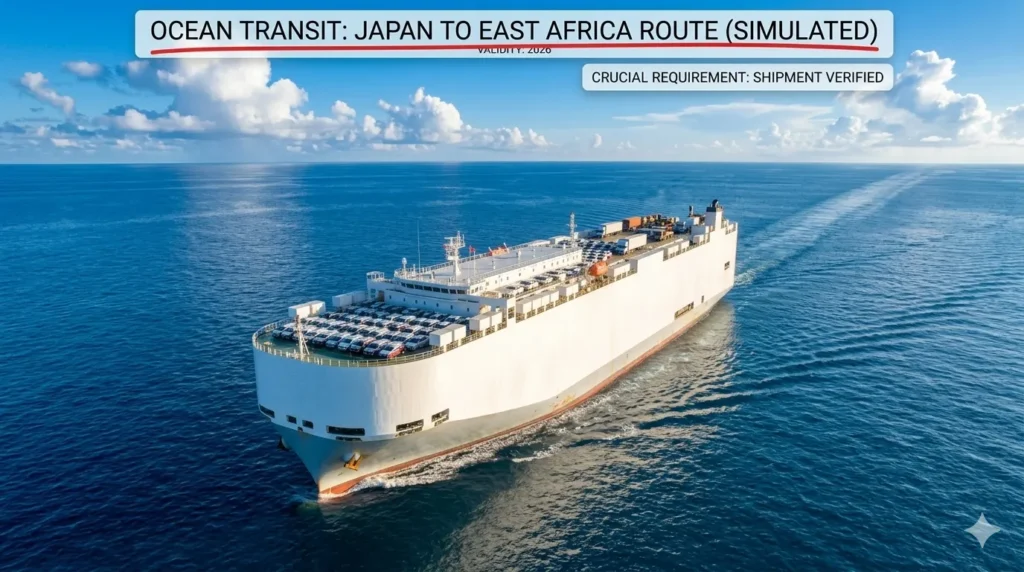
Uganda is a landlocked country, which means all vehicles imported from Japan arrive through Mombasa Port in Kenya and are then transported overland to Uganda via the Northern Corridor highway.
Top Japan Export Ports for Uganda:
- Yokohama (most popular — largest RoRo terminal)
- Kobe (good option, slightly lower port charges)
- Osaka (ideal for western Japan stock)
- Nagoya (popular for Toyota vehicles)
- Tokyo (good for premium and luxury vehicles)
Destination: Mombasa Port, Kenya → Kampala, Uganda (overland)
Estimated Transit Time: 28–42 days total
- Japan to Mombasa: 22–30 days by sea
- Mombasa to Kampala: 5–10 days overland
Shipping Methods Comparison
| Method | Cost (USD) | Transit | Best For |
|---|---|---|---|
| RoRo (Roll-on/Roll-off) | $750–$950 | 22–30 days | Standard cars, SUVs |
| Container (20ft shared) | $1,100–$1,400 | 25–35 days | Luxury, classic, modified |
| Container (20ft solo) | $1,600–$2,000 | 25–35 days | Multiple vehicles |
Pro Tip: For standard vehicles like Toyota Corolla, Honda Fit, or Nissan Note — always choose RoRo. It is significantly cheaper and just as safe. Only use container shipping for high-value vehicles above $15,000 FOB.
WARNING: Always purchase marine insurance before your vehicle leaves Japan. Insurance typically costs 1–1.5% of the CIF value and protects you against damage or loss at sea.
Import Duty & Full Tax Breakdown for Uganda 2025
This is the most important section for anyone planning to import a car from Japan to Uganda. Uganda’s duty structure is managed by the Uganda Revenue Authority (URA) under the East African Community Common External Tariff (EAC CET).
Here is the complete cost breakdown using a $8,000 FOB vehicle as our example:
Full Landed Cost Example $8,000 FOB Vehicle
| Fee | Rate | Amount (USD) |
|---|---|---|
| FOB Price (Japan) | — | $8,000 |
| Freight (RoRo, Yokohama–Mombasa) | — | $850 |
| Marine Insurance (1%) | — | $88 |
| CIF Value | — | $8,938 |
| Import Duty | 25% of CIF | $2,235 |
| VAT (Value Added Tax) | 18% of (CIF + Duty) | $2,012 |
| Excise Duty | 15% of CIF | $1,341 |
| Port Handling Fee (Mombasa) | Fixed | $380 |
| Inland Transport (Mombasa–Kampala) | Fixed | $480 |
| Inspection Fee (JEVIC/MVIL) | Fixed | $150 |
| Clearing & Forwarding (1.5%) | 1.5% of CIF | $134 |
| Uganda Registration Fee | Fixed | $120 |
| ━━━━━━━━━━━━━━━━━━━━━━ | ━━━━━ | ━━━━━━━ |
| TOTAL LANDED COST | ~$15,810 | |
| In Uganda Shillings (approx) | ~UGX 60,870,000 |
Key Tax Rates Summary:
- Import Duty: 25% of CIF value
- VAT: 18% of (CIF + Duty)
- Excise Duty: 15% of CIF value
- Infrastructure Levy: 1.5% of CIF value
Hybrid Tip: If you import a Toyota Prius, Toyota Aqua, or Honda Fit Hybrid, you may qualify for a reduced excise duty rate under Uganda’s green vehicle incentive. This can save you $200–$600 depending on engine size. Always confirm with URA before purchasing.
WARNING: Exchange rates fluctuate daily. All UGX figures in this guide are approximate. Your clearing agent will calculate the final duty in local currency on the day of customs entry.

Step-by-Step Import Process — Japan to Uganda
Here is exactly how to import a car from Japan to Uganda in 2025, from finding your vehicle to driving it home in Kampala.
Step 1: Find Your Vehicle at a Japanese Auction Japan has the world’s most transparent used car auction system. Major auction houses include BCA, USS, TAA, JU, and Aucnet. Each vehicle has an auction sheet with a grade (3.5 and above recommended), mileage, and full condition report. You can access auctions through a licensed Japanese export agent.
Step 2: Place Your Bid or Purchase Directly You can bid through your export agent at auction or purchase from a Japanese dealer stock. Always check the auction sheet grade carefully — Grade 4 and above means excellent condition. Confirm the manufacture date, mileage, and that the vehicle is RHD before bidding.
Step 3: Export from Japan Once purchased, your agent arranges the export certificate (Jidosha Yushutsu Shomeisho) and vehicle deregistration. This process takes 7–14 days. The vehicle is then delivered to the Japan export port.
Step 4: Shipping & Transit Your agent books a RoRo or container slot on the next available vessel to Mombasa. You receive a Bill of Lading — keep this document safe, it is your proof of ownership during transit. Marine insurance is arranged at this stage.
Step 5: Arrival at Mombasa Port, Kenya The vessel arrives at Mombasa after 22–30 days at sea. Your Ugandan clearing agent (based in Mombasa) is notified and begins preparing customs documentation. Port charges are paid at this stage.
Step 6: Customs Clearance at Mombasa Your clearing agent submits the full document package to Kenya Revenue Authority (KRA) at Mombasa. Kenya is a transit country for Uganda-bound vehicles, so no Kenyan duty is charged — only a transit bond is lodged.
Step 7: Inland Transport to Uganda The vehicle is loaded onto a truck transporter or driven by a professional driver from Mombasa to Kampala via the A104 Northern Corridor highway. This journey takes 5–10 days depending on border crossing wait times at Malaba or Busia.
Step 8: Uganda Customs Clearance & Duty Payment Upon arrival at the Uganda border or Kampala customs, your local clearing agent submits documents to URA. Duty, VAT, and excise are assessed and must be paid before the vehicle is released. URA uses the Electronic Single Window system for fast processing.
Step 9: Vehicle Inspection All imported vehicles must pass a roadworthiness inspection by the Uganda Vehicle Inspection Centre (UVIC). The inspection checks mechanical condition, emissions, and safety. Fee is approximately UGX 450,000.
Step 10: Registration & Number Plates After passing inspection, you register the vehicle with the Ministry of Works and Transport. You receive Uganda number plates and the vehicle logbook (V5). Registration fee is approximately UGX 450,000.
Step 11: Drive Home! Your Japanese car is now legally registered in Uganda and ready to drive. Welcome to the road!
Required Import Documents Complete Checklist
Missing even one document can delay your clearance by weeks and result in expensive demurrage storage charges at Mombasa Port.
Documents You Must Have:
- Original Export Certificate from Japan (Jidosha Yushutsu Shomeisho)
- Original Bill of Lading (from shipping line)
- Commercial Invoice (showing FOB price in USD)
- Packing List
- Marine Insurance Certificate
- Deregistration Certificate from Japan
- Pre-Export Verification of Conformity (PVoC) — KEBS inspection certificate
- Import Declaration Form (IDF) — submitted to URA
- Valid Passport / National ID (importer)
- Uganda Revenue Authority PIN (for duty payment)
- Transit Bond documents (Mombasa clearance)
WARNING: Uganda requires a Pre-Export Verification of Conformity (PVoC) inspection in Japan before the vehicle is shipped. This is conducted by KEBS-approved inspectors (Bureau Veritas, SGS, Intertek). Without this certificate, your vehicle can be rejected at Uganda customs. Arrange this inspection through your Japanese export agent.
Pro Tip: Start preparing your IDF (Import Declaration Form) with URA while your vehicle is still at sea. This saves significant time once it arrives at Mombasa.
Top 10 Japanese Vehicles Most Imported to Uganda
Ugandan importers have very clear preferences — they want reliable, fuel-efficient, affordable vehicles that can handle both Kampala city traffic and Uganda’s rural roads.
- Toyota Land Cruiser Prado — Uganda’s most prestigious SUV. Handles all terrain from Kampala tarmac to upcountry murram roads perfectly. Extremely high resale value.
- Toyota Harrier — Premium SUV at an affordable price. Hugely popular with professionals and business owners in Kampala. Excellent fuel economy for its size.
- Toyota Succeed / Probox — The workhorse of Uganda. Massively popular with businesses, NGOs, and taxi operators. Legendary Toyota reliability at the lowest price point.
- Toyota RAV4 — Perfect balance of city comfort and off-road capability. Popular with families and expats. Available in both petrol and hybrid.
- Toyota Hilux Surf (4Runner) — Iconic in Uganda for upcountry travel. Diesel variants are especially popular for their torque and fuel range on long journeys.
- Honda Fit / Jazz — Most popular small car in Uganda. Exceptional fuel economy, spacious interior despite small size, very affordable. Perfect for Kampala city use.
- Nissan X-Trail — Strong demand from families needing space and SUV capability. Affordable entry point into the SUV segment.
- Toyota Premio / Allion — Premium saloon at budget price. Popular with government officials, lawyers, and professionals. Smooth, comfortable, and very reliable.
- Subaru Forester — Favourite among adventure-seekers and young professionals. AWD capability makes it ideal for Uganda’s varied terrain.
- Toyota Aqua (Prius C) — Uganda’s fastest-growing import segment. Hybrid fuel economy saves owners millions of shillings in fuel annually in Kampala’s heavy traffic.
Frequently Asked Questions (FAQs)
Q1: How long does shipping from Japan to Uganda take in total?
The total journey from Japan auction to your driveway in Kampala typically takes 45–70 days. This includes 7–14 days for Japan export processing, 22–30 days sea transit to Mombasa, 5–10 days overland to Kampala, and 7–14 days for Uganda customs clearance and registration. Working with an experienced agent can significantly reduce the clearance time.
Q2: Can I import a left-hand drive car to Uganda?
No. Uganda requires Right-Hand Drive (RHD) vehicles only, which aligns perfectly with Japan’s road traffic. Japan is almost entirely RHD, so the vast majority of Japanese used vehicles naturally meet Uganda’s requirement.
Q3: What is the maximum vehicle age for Uganda?
Uganda allows vehicles up to 8 years old from the year of manufacture. In 2025, this means your vehicle must have been manufactured in 2017 or later. This rule is strictly enforced by URA and there are no exceptions.
Q4: Do I need a clearing agent to import a car to Uganda?
Technically no, but practically yes. The customs clearance process involves URA’s Electronic Single Window system, transit bond lodging in Mombasa, coordination with Kenya Revenue Authority, PVoC certificate verification, and multiple document submissions. Unless you have direct experience with this process, a licensed clearing agent is essential and will save you significant money in avoided mistakes and delays.
Q5: What is the cheapest Japanese car to import to Uganda in 2025?
The Toyota Succeed/Probox or Honda Fit are consistently the most affordable Japanese cars to import to Uganda. A clean Grade 4 Honda Fit (2018, 1300cc) can be purchased in Japan for $3,500–$5,000 FOB, with a total landed cost in Uganda of approximately UGX 28–38 million including all duties and fees.
Q6: Is it cheaper to import a hybrid or petrol car to Uganda?
In most cases, yes — importing a hybrid is cheaper overall. While the Japan FOB price of a hybrid is slightly higher than an equivalent petrol vehicle, the reduced excise duty in Uganda partially offsets this. More importantly, a hybrid will save you UGX 80,000–150,000 per month in fuel costs in Kampala’s stop-and-go traffic, making it significantly cheaper to own over 3–5 years.
CONTENT SUMMARY CARD
| Field | Details |
|---|---|
| COUNTRY | Uganda |
| IMPORT DUTY | 25% of CIF |
| VAT | 18% |
| EXCISE DUTY | 15% of CIF |
| MAX VEHICLE AGE | 8 Years (2017 or newer in 2025) |
| STEERING | RHD (Right-Hand Drive) |
| DESTINATION PORT | Mombasa, Kenya (then overland) |
| SHIPPING TIME | 45–70 days total (Japan to Kampala) |
| SHIPPING COST RoRo | $750–$950 USD |
| TOTAL LANDED COST | ~$15,810 USD (on $8,000 FOB vehicle) |
| IN UGX (approx) | ~UGX 60,870,000 |
| HYBRID BENEFIT | Yes — reduced excise duty |
| PVOC REQUIRED | Yes — KEBS approved inspector |
| BEST SELLING MODEL | Toyota Land Cruiser Prado |
| BEST VALUE MODEL | Honda Fit / Toyota Aqua |
| GOVERNING AUTHORITY | Uganda Revenue Authority (URA) |
| ARTICLE WORD COUNT | ~2,100 words |
| IMAGES GENERATED | 6 |
Disclaimer
Importing a car from Japan to Uganda in 2025 is a smart, cost-effective decision when done correctly. Japan offers the best quality used vehicles in the world at competitive prices, and Uganda’s relatively straightforward import process makes it accessible to both first-time importers and experienced dealers.
The key to a successful import is preparation — verify vehicle eligibility before bidding, calculate your total landed cost before committing to a price, gather all documents in advance, and work with a licensed clearing agent who knows the URA process inside out.
